

In the first two parts of our series, we learned the importance of heavy compound exercises as a foundation and the precise control of training parameters for muscle building. But to move maximum loads safely and without injury during squats, deadlifts, or overhead presses, you need an ultra-stable foundation. Sports science shows that strength is generated in the extremities, but it is transmitted through the body's core. Welcome to Advanced Core Training.
The 3 Pillars of Spinal Stability: Why Your Nervous System Plays the Main Role
In biomechanics (according to Panjabi's well-known model), the stability of our spine is secured by the interplay of three systems:
- The passive system: Your vertebrae, joints, ligaments, and intervertebral discs. They provide the structure but cannot actively adapt.
- The active system: The surrounding trunk muscles that generate mechanical tension.
- The neural system (nervous system): The absolute control boss. It constantly measures forces and activates muscles in milliseconds to protect the spine.
Effective core training starts right here: It improves neuromuscular control so that your nervous system instinctively builds the right tension under heavy loads on the barbell.
Local Stabilizers vs. Global Movers: The Difference Between Core Strength and a Six-Pack
To train the trunk muscles specifically, we need to functionally divide them into two groups:
The local stabilizers, such as the deep transverse abdominal muscle (M. transversus abdominis) and the short, multi-pennate back muscles (Mm. multifidi), lie deep within the body, directly on the vertebrae. They produce hardly any visible movement but segmentally stabilize the spine. They anticipate movement – meaning, ideally, they fire milliseconds before you execute a movement in your arms or legs.
The global movers, such as the rectus abdominis muscle (M. rectus abdominis) or the large back extensors (M. erector spinae), are superficial. They are responsible for large strength outputs and movements. However, if your deep, local stabilizers are weak, the global muscles have to take over the stabilization work. The result: energy losses during heavy lifts, reduced performance, and long-term back pain.
The "Core Bracing" Principle: Create Perfect Cylinder Stability
Forget simply "sucking in your stomach." To create maximum core stability, we use the sports science principle of Core Bracing (according to Stuart McGill). Imagine your torso as a closed cylinder or a barrel: The diaphragm forms the lid, the pelvic floor forms the bottom, and the abdominal and deep back muscles form the stable wall. By simultaneously and consciously tensing all the surrounding trunk muscles, high intra-abdominal pressure is created, which stabilizes your lumbar spine like an internal corset, making it rock-solid.
Our tip for feeling it yourself:
Place your hands on your sides at your waist (just above the iliac crest), so your fingers are on your stomach and your thumbs on your lower back. Now, if you give a strong cough or laugh, you will immediately feel how the entire muscle wall reflexively pushes outwards and becomes firm. This all-around palpable, three-dimensional basic tension is the core bracing that you should actively build up before every heavy lift.

1. Trigger Segmental Stability with the Balance Board
Since the deep, local stabilizers primarily react to unpredictable stimuli and micro-movements, training on unstable surfaces is highly effective. The rollholz Balance Board forces your body into permanent compensatory movements in the sagittal and frontal planes – i.e., during tilting movements forwards and backwards, as well as when balancing sideways.
The exercise: Perform a classic forearm plank position, with your forearms resting on the Balance Board. Due to the instability in all directions, your nervous system has to massively engage the transverse abdominal muscle (M. transversus abdominis) to maintain the position. This trains the reactive core stability that you will later need to brace against heavy loads during your basic exercises.

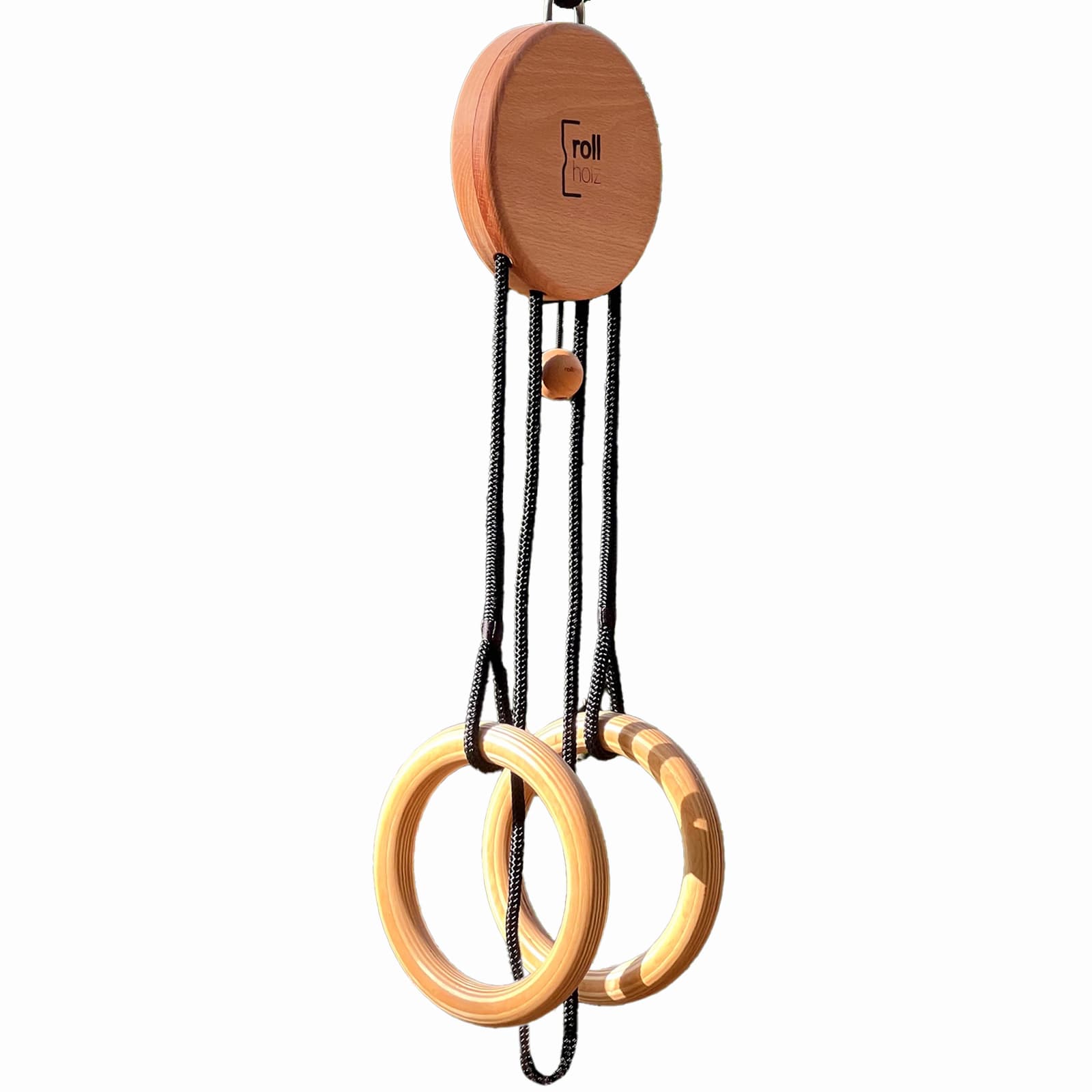
2. Anti-Rotation and Movement Control with the Suspension trainer
Real core training in athletics usually means not creating movement, but preventing movement. We categorize this into anti-extension (resistance against hyperextension), anti-lateral flexion (resistance against sideways bending), and anti-rotation (resisting rotational forces in the transverse plane). The rollholz Suspension trainer is the ultimate tool for this.
The exercise: Place your feet in the loops of the suspension trainer and get into a push-up position. Now, pull both knees simultaneously and in a controlled manner under your body towards your chest. As an advanced alternative, pull your knees diagonally alternately towards the opposite side of your chest. Your core must work massively against the sagging of your pelvis (anti-extension) and – especially in the diagonal variation – against sideways rotation (anti-rotation). This is the absolute elite level of core training.
Conclusion: Core First, Then Max Strength
Scientifically based Advanced Core Training is the link between your muscle mass and genuine, usable athleticism. By integrating exercises on the Balance Board and with the Suspension trainer firmly into your weekly routine, you optimize the interplay between your nervous system and deep muscles. You prevent energy loss during your compound exercises and effectively protect your spine from overload.








Leave a comment
This site is protected by hCaptcha and the hCaptcha Privacy Policy and Terms of Service apply.