
Anyone who has ever rolled an ankle knows the feeling: the foot gives way before you can react. What plays a role here is proprioception, the depth perception of your joints. When well trained, it reacts faster. Here you will find out what is behind the term, how to train it with simple means and how a Balance Board makes the training more varied.
What is proprioception?
Proprioception (also known as deep sensitivity) describes the body's ability to sense its position and movement without looking. Sensors in muscles, tendons and joint capsules constantly report to the brain how a joint is positioned and how much load it is under. This is how you can walk down a staircase in the dark or keep your balance on uneven ground.
In proprioceptive training you work on this perception in a targeted way: you train on an unstable surface or with reduced support, so that muscles and nervous system have to readjust quickly and finely. This can improve joint stability and reaction ability, and it is one of the building blocks athletes use to prevent injuries.
Who benefits from proprioceptive training?
- anyone who has ever rolled their ankle and wants to regain confidence in it
- runners, ball and racquet sport athletes whose ankles and knees have to absorb a lot (see also our article Proprioception and the Ankle in Running)
- anyone who sits a lot and rarely challenges their feet in everyday life
Important: After a fresh injury, or with pain, swelling or instability, see a doctor or physiotherapist first. This article does not replace treatment.
Level 1: Exercises without equipment
Start on a firm floor, next to a wall or a chair.
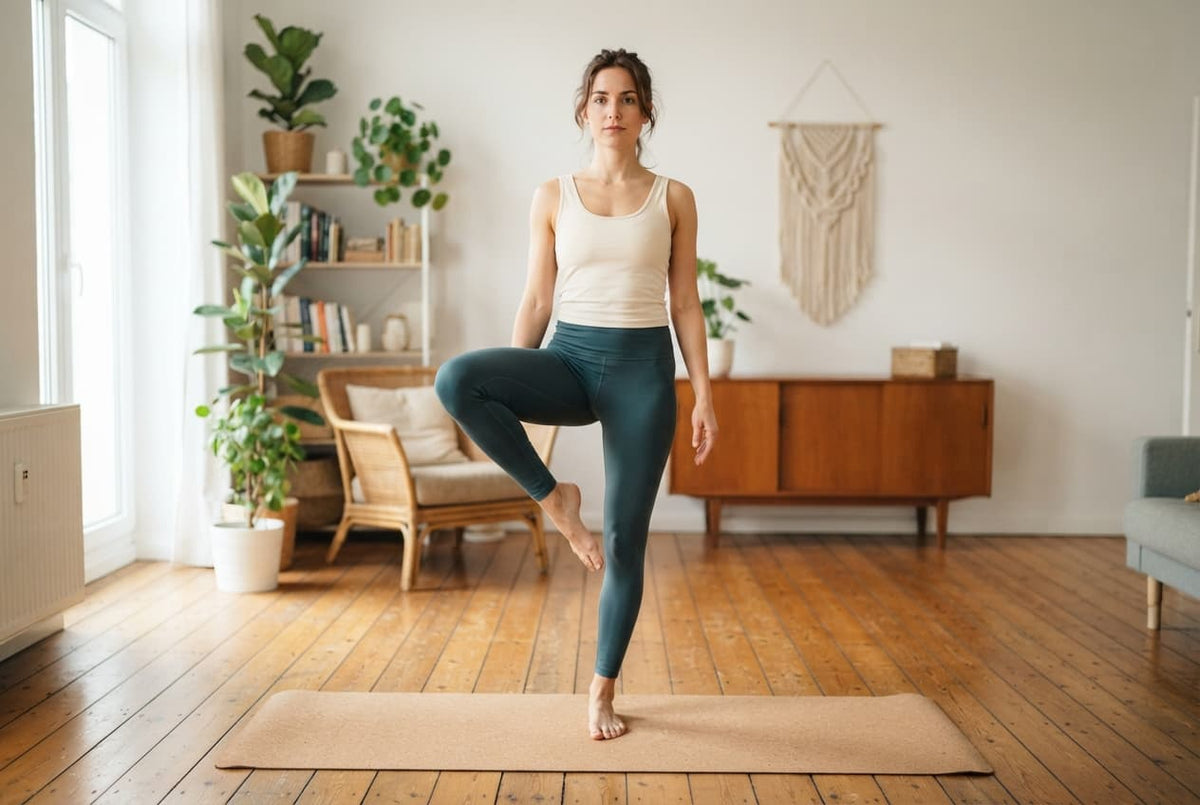
Single-leg stance
Shift your weight onto one leg, lift the other slightly and hold for 20 to 30 seconds. Keep the knee slightly bent and look at a fixed point. Switch sides.
Single-leg stance with eyes closed
The same exercise, but without the help of your eyes. Now the ankle has to do the work. If you feel unsteady, hold on to the wall with a fingertip.
Toe and heel stance
Slowly switch between standing on your toes and on your heels, with a short hold each time. This trains the calf and shin muscles that guide the ankle. If your calves or shins feel tense during this, the exercises in our articles on Calf and Achilles Tendon and Shin will help.
Level 2: Unstable surface: the Balance Board
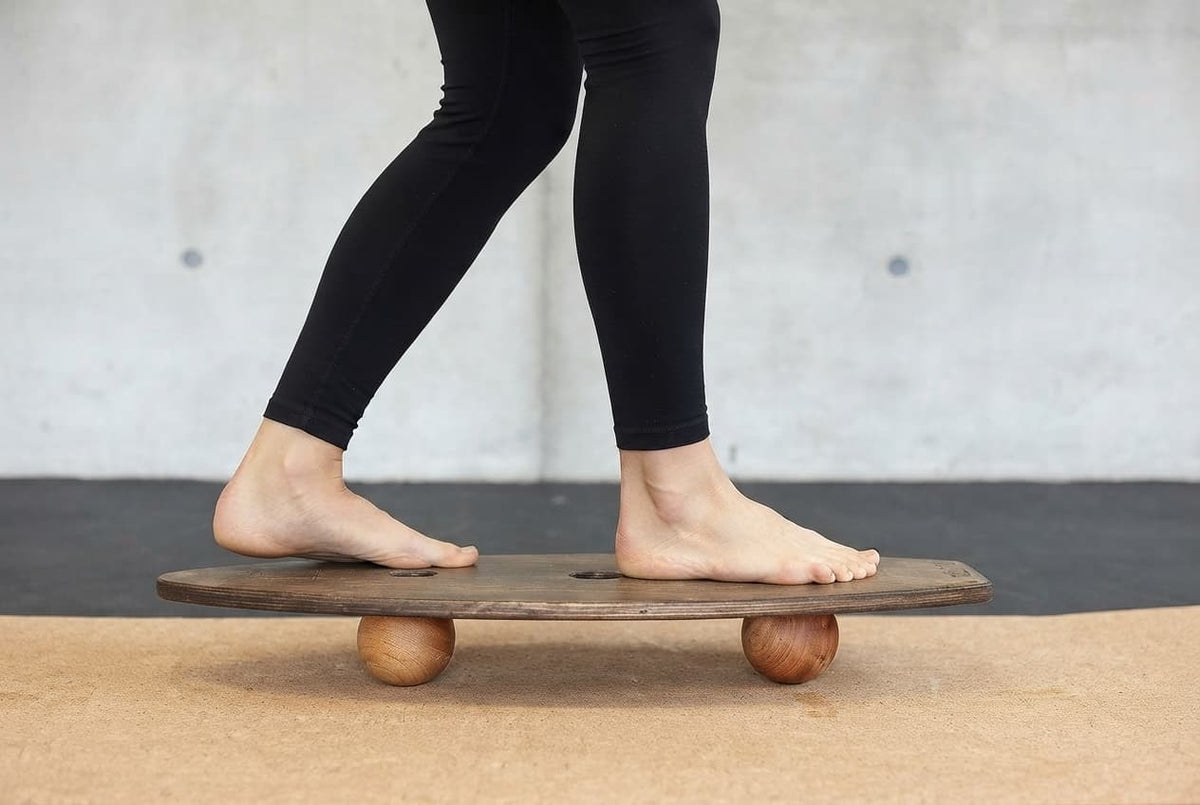
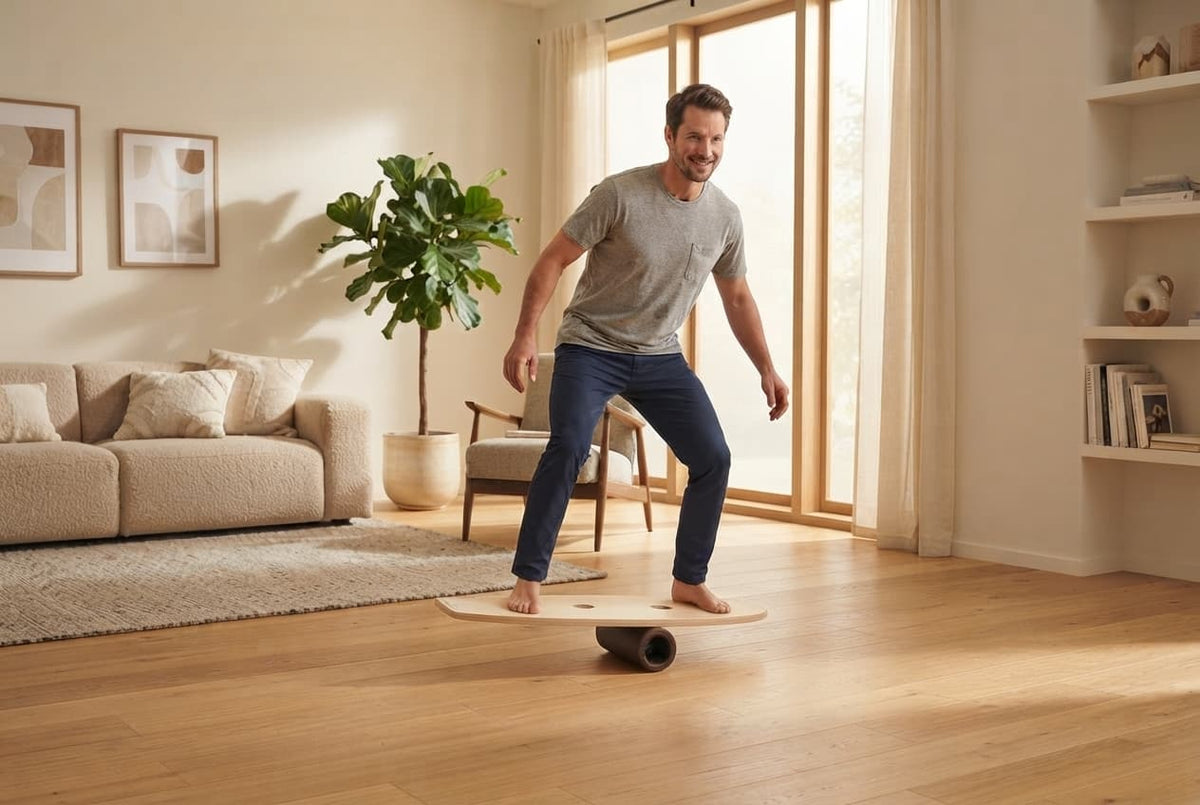
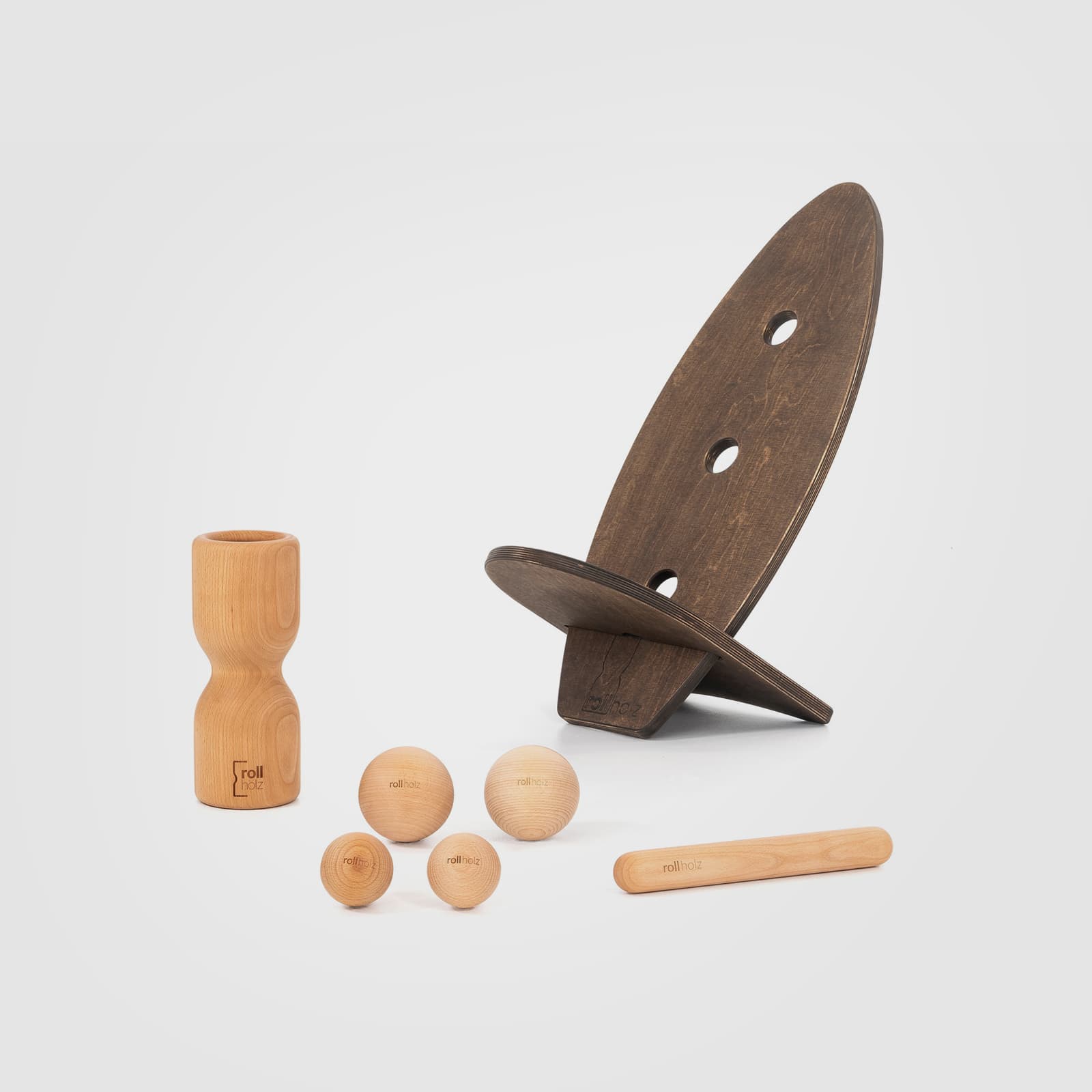
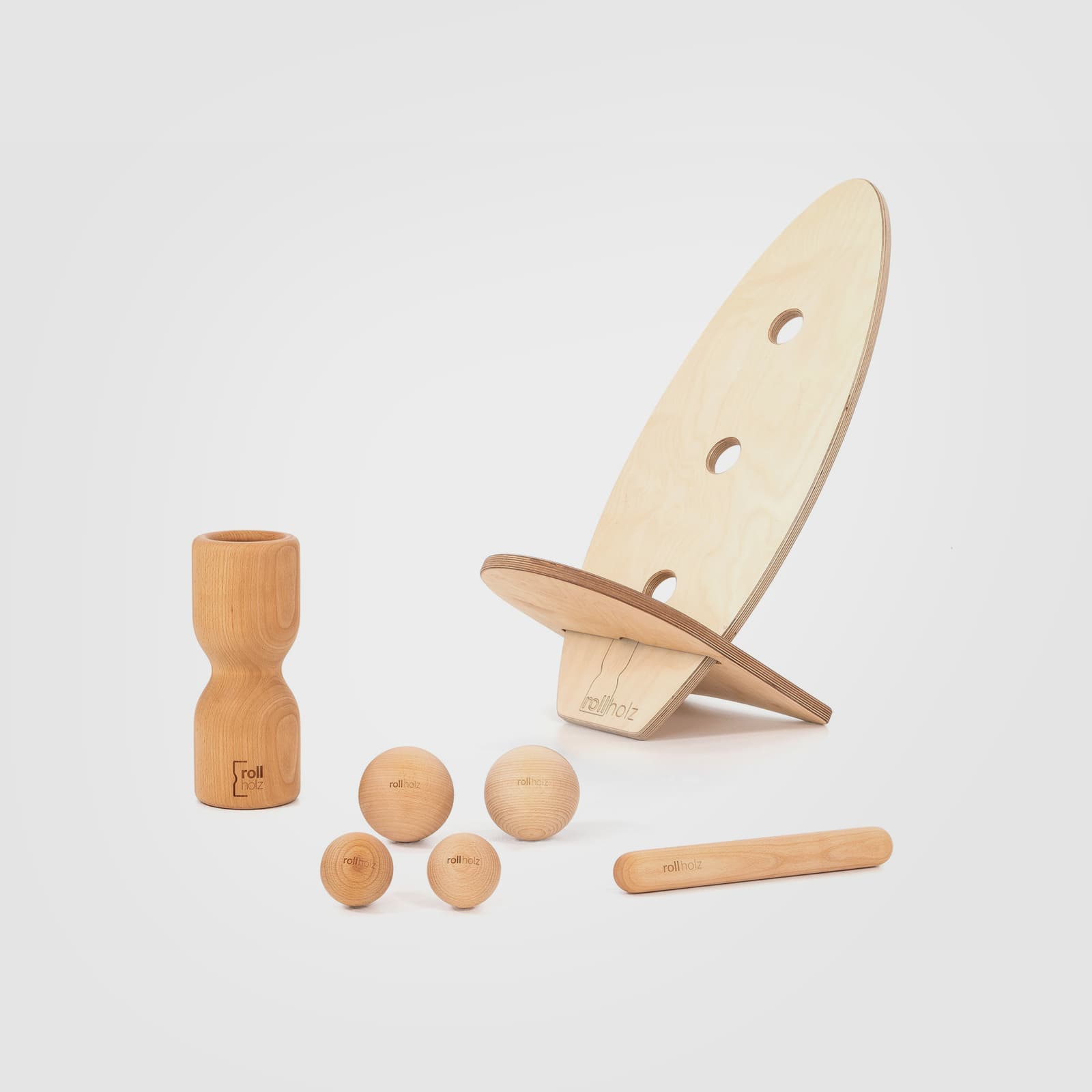
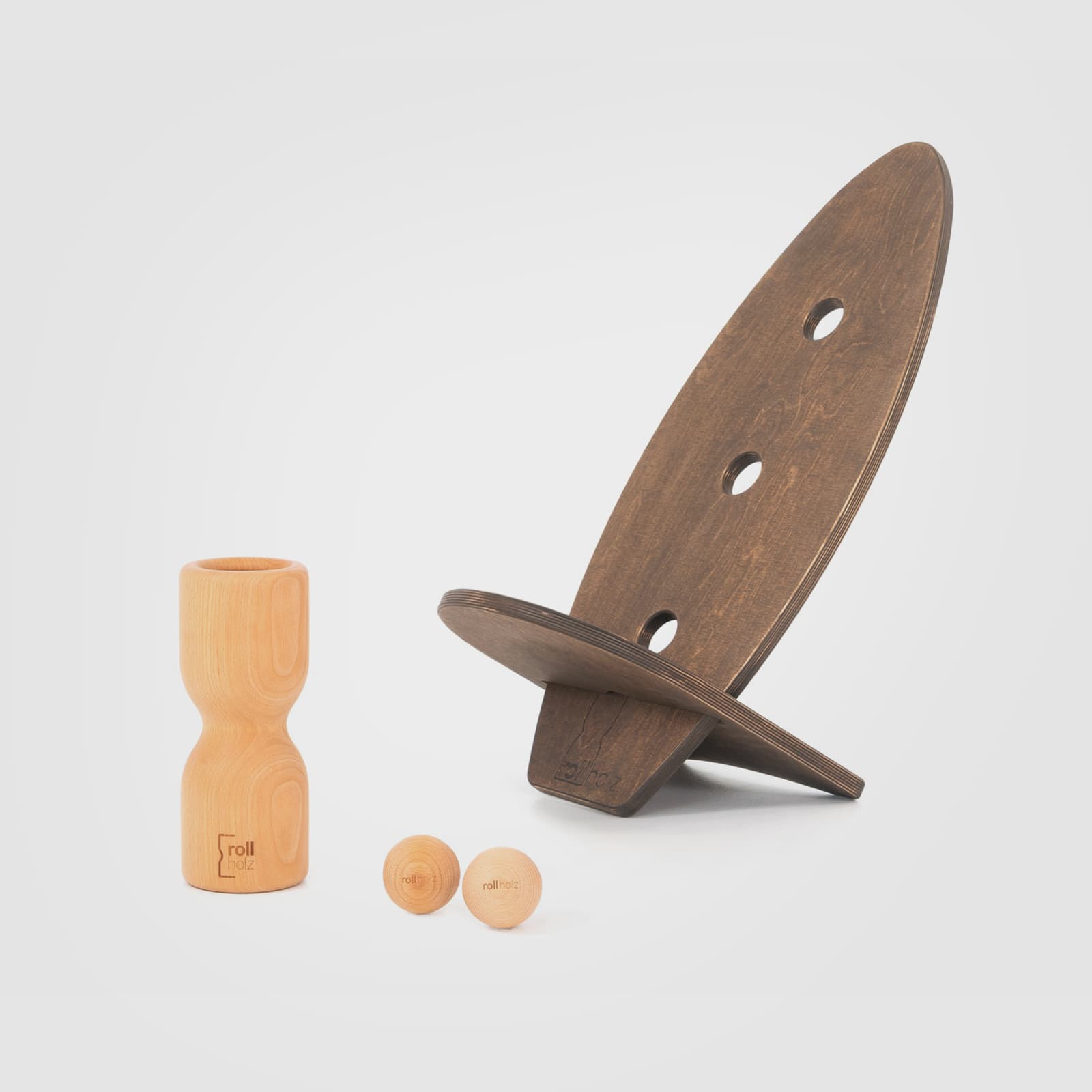
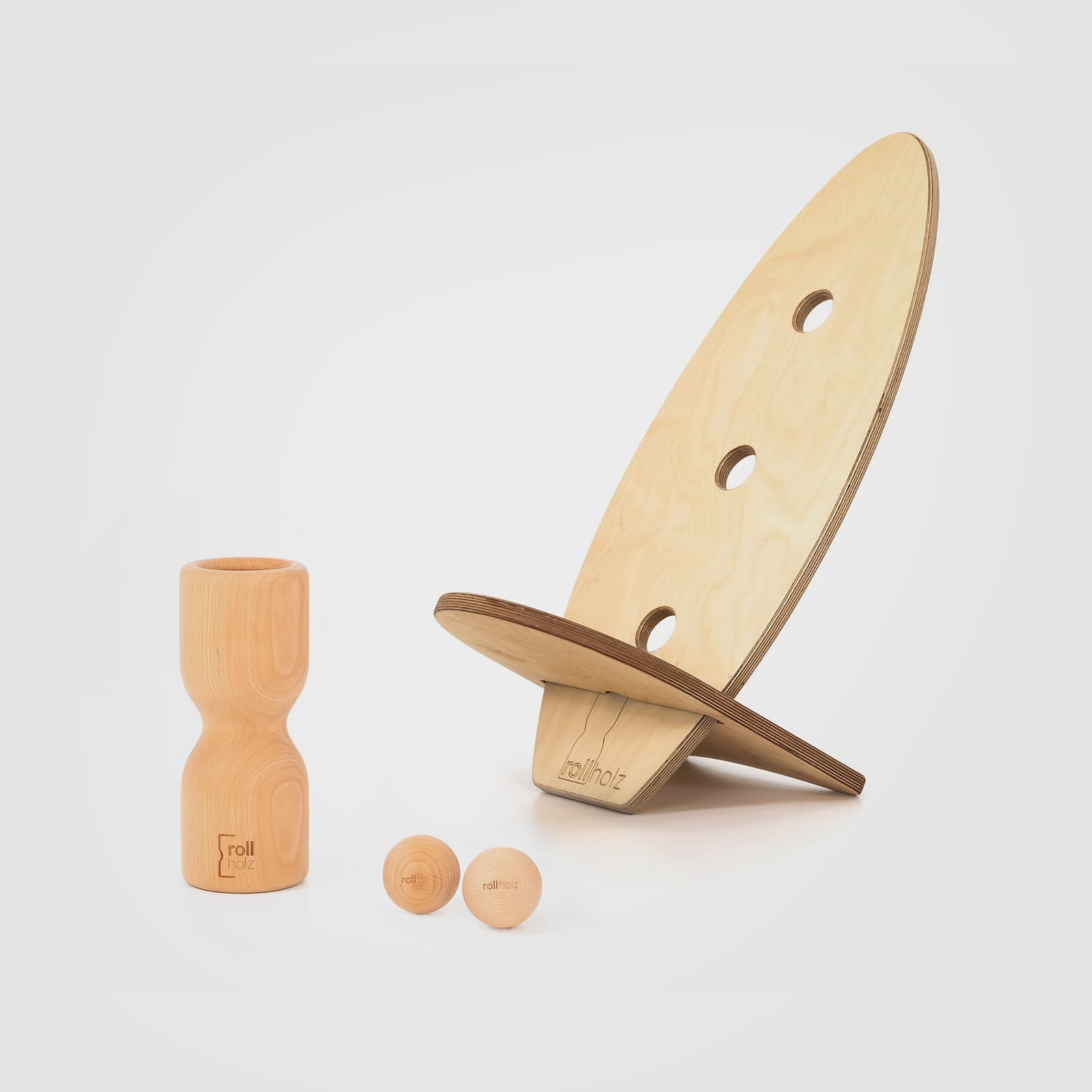
A Balance Board turns the stable floor into a surface that gives way. Your ankles constantly have to make tiny corrections, exactly what you need in everyday life when you roll an ankle. With the rollholz Balance Board you adjust the difficulty through the accessory underneath.
Two balls: the ideal start for the ankle
Place two balls (7 cm) under the outer holes of the large board. The board now only tilts around one axis, so you only have to stabilise in one direction, which is easier than with a single ball. For training ankle stability, the 7 cm balls are usually enough. The 10 cm balls are taller, the board tilts more, and the exercise becomes much more demanding.
Exercise: Getting on and balancing
First step on above one ball, where the board stands stable, and then place your second foot on the other ball. If both feet stand on the imaginary line between the two balls, the board tilts forwards and backwards: you train flexion and extension (bending and stretching) in the ankle.

If you instead place one foot on each side of this line, you have to balance sideways: now supination and pronation in the ankle are called for – the same movement as when you roll an ankle, but here controlled and in small doses. This works just as well with the mini roller on the small board.
Exercise: Tandem stance

The progression of the first orientation: place your feet one behind the other on the board above the two balls, so that the track width becomes narrower. Bend your knees slightly and build tension in your legs, glutes and core. The closer your feet are together, the harder the balancing becomes. Keep the board as level as possible and keep your gaze on a fixed point.
Exercise: Squat

From a secure stance, slowly go into a squat. Keep your back straight and don't let your knees fall inwards. Your arms help you balance. Here you additionally train knee alignment.
Exercise: Lunge

The front foot stands in the middle of the board, the back foot on the floor. Bend both knees and try to bring the back knee to the floor. Then slowly come back up. This exercise challenges ankle and knee at the same time. Progression: the more weight you shift onto the front foot standing on the board, the more demanding the exercise becomes – the hardest variant is the single-leg stance on the board.
Level 3: Progression
- One ball: The board now tilts in all directions. Start with weight shifts while standing.
- Small range of motion: Reduce the swing range by shifting your weight and place your feet side by side.
- Catching a ball: While standing, throw a ball to yourself or from one hand to the other. The distraction challenges your reaction ability.
You can find all exercises in detail in our article Balance Board Exercises: 15 Exercises from Easy to Hard.
How often should you train?
Two to three times a week for 5 to 10 minutes is enough to start with. Short and regular beats rare and long. Make sure you always practise in a stable environment with a wall or handrail and on a soft surface, such as a cork mat.
Frequently asked questions
What is the difference between proprioception and balance?
Balance is the performance, proprioception an important building block of it. Balance also includes the inner ear and the sense of sight.
Can I prevent rolling my ankle with proprioceptive training?
Studies suggest that balance training can reduce the risk of injury to the ankle, especially in athletes who have rolled their ankle before. There are no guarantees. The training complements strength, mobility and suitable shoes.
Is a Balance Board suitable for this?
Yes, it is one of several devices. The advantage of a wooden board with roller or balls: you set the difficulty yourself. The Balance Board Guide gives you an overview of the variants.


Leave a comment
This site is protected by hCaptcha and the hCaptcha Privacy Policy and Terms of Service apply.